
Amethyst Geodes
How to Tell If an Amethyst Geode Is Real: 9 Checks Before You Buy
Aug
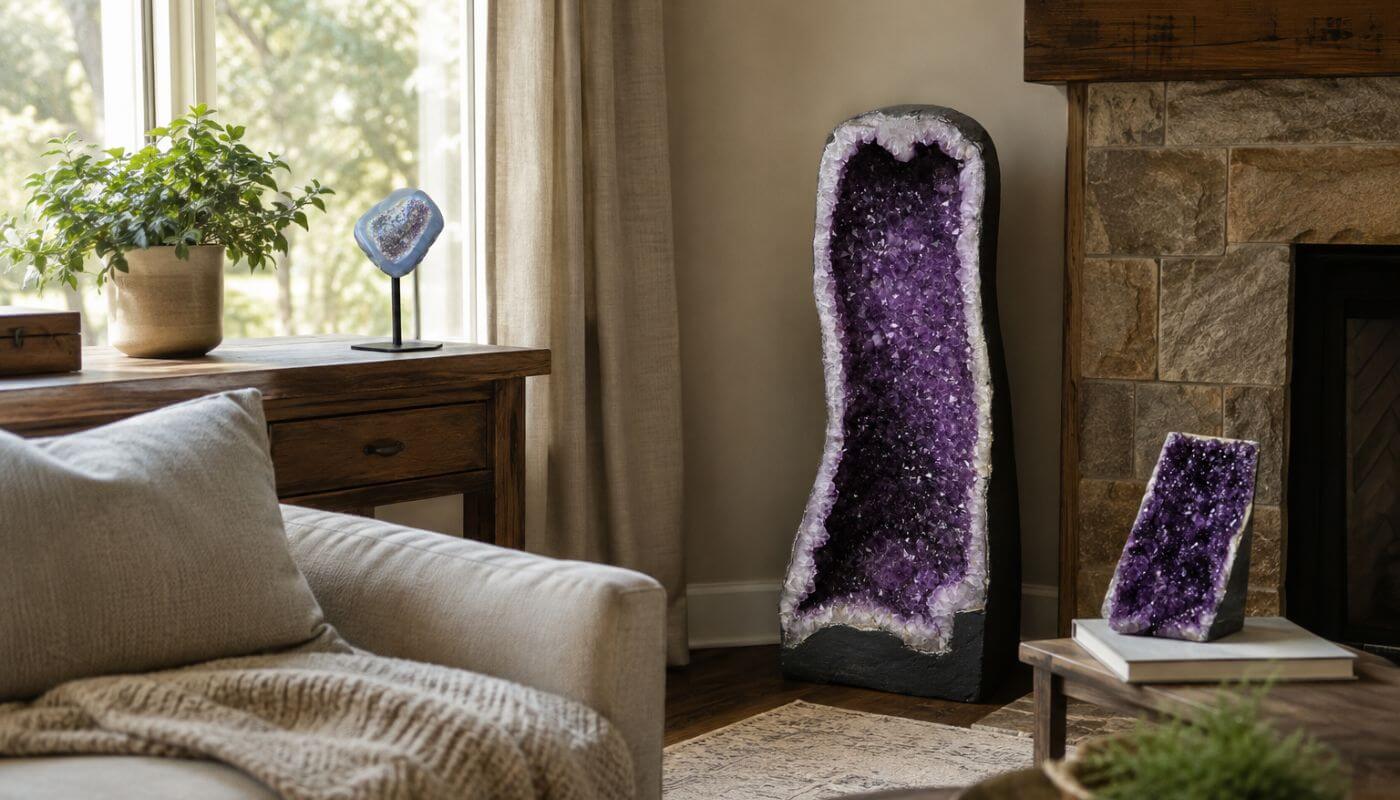
An amethyst geode can make a great addition to a home. From compact clusters to tall cathedral formations, every natural specimen has its own combination of colour, crystal shape, mineral layers and character.
However, buying a geode – especially online – raises an important question: how can you tell whether an amethyst geode is real?
Natural amethyst may be confused with dyed quartz, coloured glass, resin decorations or reconstructed pieces. Lighting and image editing can also make a specimen appear darker or brighter than it looks in person. These nine checks can help you assess a geode and buy with greater confidence.
A natural amethyst geode usually has genuine quartz points, variations in colour and crystal growth, a geological outer matrix, and a believable transition from rock to quartz and purple amethyst. No single feature proves authenticity, so assess several characteristics together and buy from a transparent specialist seller.
What Does “Real Amethyst” Mean?
Amethyst is the purple variety of quartz. Its colour ranges from pale lilac to deep violet and may include reddish or bluish tones. Natural specimens can also display lighter and darker areas in the same formation.
Buyers may be comparing a naturally formed geode with dyed quartz, glass, resin, an assembled decoration or laboratory-grown amethyst. A genuine geode may also have a polished rim, painted exterior, repaired area or fitted stand. These finishing methods do not automatically make it fake, but significant treatments and repairs should be disclosed.
The checks below are buying indicators, not a replacement for professional gemmological testing.
1. Look for Natural Variations in Colour
Natural amethyst is not limited to one shade. A geode may contain pale lavender, medium purple and deep violet areas, sometimes within the same cluster.
You may notice darker crystal tips, paler quartz near the base or slight differences between neighbouring points. These variations often reflect natural growth.
Uniform colour is not automatic proof of an imitation, as some high-quality specimens can be richly coloured. However, an unusually vivid purple surface with no visible depth deserves closer examination.
Consider whether the colour appears to be part of the crystals or looks like a stain, coating or photographic effect. Whenever possible, view images taken in neutral light.
2. Examine the Crystal Points
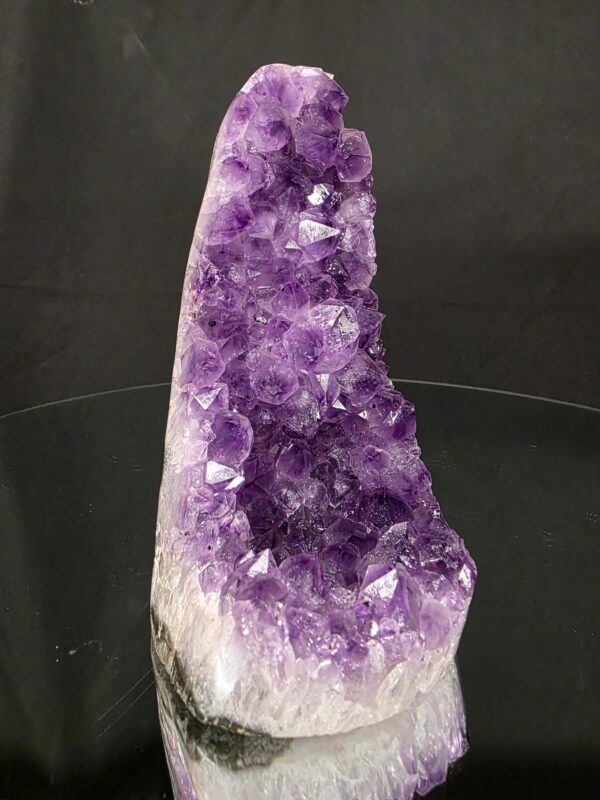
Natural geodes form as quartz crystals grow into an open cavity. This usually creates points of different sizes, angles and levels of clarity.
A genuine formation may contain larger crystals surrounded by smaller points, crowded areas, inclusions, contact marks or occasional chips. Quartz often develops six-sided forms with pointed terminations, although tightly packed crystals may not show every side clearly.
Be cautious if every point looks identical, repeated or moulded. Visible seams, rounded plastic-like tips or crystals attached to an artificial backing may indicate a manufactured decoration.
Regularity alone is not proof of imitation. Selected natural geodes can have beautifully defined points, so assess their shape together with the colour, base and mineral layers.
3. Inspect the Outer Rock and Matrix
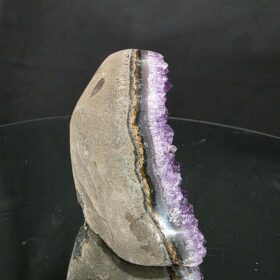
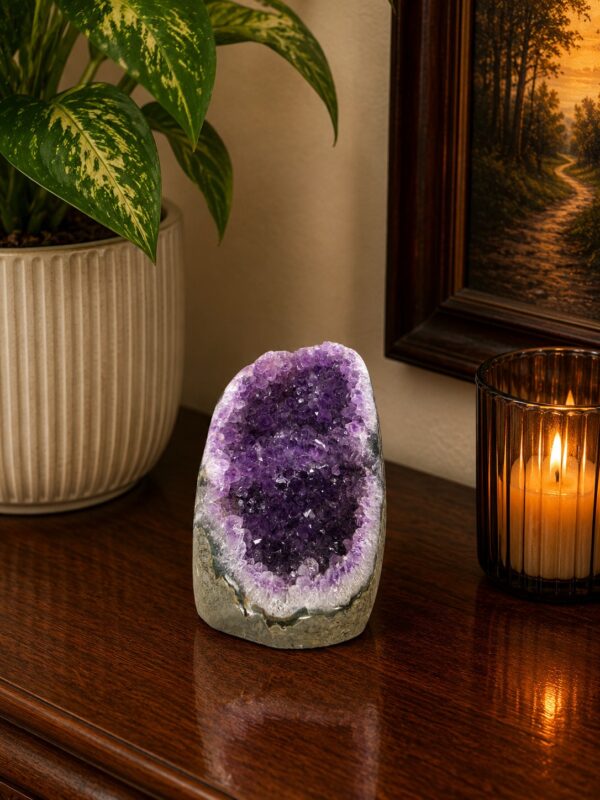
The crystals in a geode formed inside a cavity in rock, so a natural specimen should have a convincing geological structure around or behind the amethyst.
Depending on how it has been prepared, you may see rough rock on the back, a dark or greenish outer layer, a cut rim, pale quartz beneath the amethyst or a flattened base.
A painted exterior, polished edge or fitted stand is common and does not automatically mean the geode is artificial. What matters is whether the outer rock, inner layers and crystals appear naturally connected.
If the purple material seems to sit on plastic, foam or an unrelated base, request clearer close-up photographs.
4. Look for Natural Mineral Layers
The boundary between the outer rock and the purple crystals can reveal useful information.
Many amethyst geodes show rough host rock, chalcedony or agate, pale quartz and then purple amethyst points. These layers may be obvious on some specimens but thin or partly hidden on others.
Visible agate or quartz layers support the geological appearance of a geode, but their absence does not prove that it is false. Not every cut reveals the same structure.
Look for a gradual, believable transition from the outside to the crystalline centre. A purple coating placed directly over an obviously manufactured surface would be more concerning.
5. Check for Dye in Cracks and Crevices
Quartz can be artificially coloured, particularly when dye collects in fractures and porous areas.
Examine close-up photographs in white or natural light. Look around cracks, spaces between crystal points, chipped surfaces and pale quartz near the rim. Warning signs may include intense purple colour concentrated inside fractures, visible residue or painted-looking patches.
Use this check carefully. Naturally darker areas can occur during crystal growth, so colour inside a crevice is not conclusive evidence of treatment.
Do not apply solvents or chemicals. Ask whether the geode has been dyed, coated, heated, repaired or otherwise treated.
6. Watch for Glass, Resin or Moulded Parts
Some decorative imitations are made from coloured glass, resin or assembled components.
Possible warning signs include mould lines, repeated points, a lightweight hollow backing, visible glue, resin connecting crystals or a uniformly glossy finish across both the crystals and base. Large rounded bubbles or flow-like patterns may also occur in manufactured glass.
Treat these as warning signs rather than proof. Natural stones can contain inclusions, and some details are difficult to judge from photographs.
For an online purchase, request close-ups rather than relying on one polished marketing image.
7. View the Exact Geode in Different Lighting
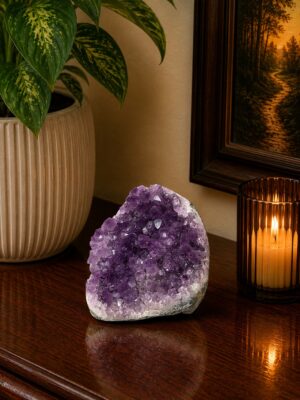
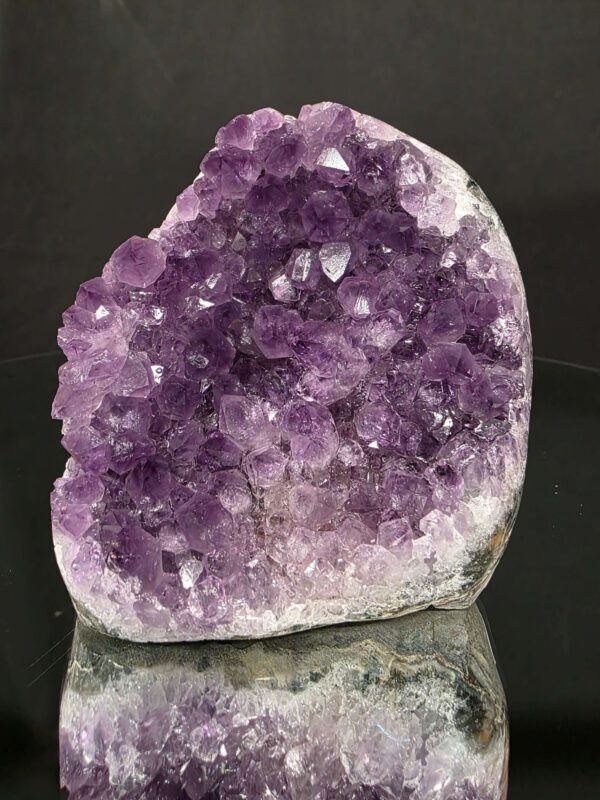
Lighting, camera settings and editing can significantly change amethyst’s appearance. Deep purple crystals may look almost black in low light, while pale specimens can appear richer under coloured LEDs or increased saturation.
Look for photographs of the exact piece from the front, sides and back. Close-ups should show the crystal points, outer matrix and natural marks. The listing should also provide accurate height, width, depth and weight.
Video is particularly useful because movement reveals depth, sparkle, shape and colour variation more clearly than one still image.
At Jewel Crystals, individual geodes are shown through product-specific photographs or videos, together with their measurements and approximate weight. This helps buyers assess the actual specimen rather than a generic image.
8. Ask About Origin, Treatments and Repairs
A responsible seller should answer sensible questions about a valuable mineral specimen.
Ask where the geode was sourced, whether the images show the exact piece and whether it has been dyed, coated, repaired or stabilised. You can also ask whether the exterior has been painted, a stand added or damaged areas restored.
Brazil and Uruguay are well-known sources of large amethyst geodes, but a claimed origin does not prove authenticity by itself. The seller’s knowledge, details and the physical characteristics of the piece should support the claim.
A natural specimen may be stabilised after mining or transport. This does not make the crystals fake, although significant repairs should be disclosed because they can affect appearance and value.
9. Assess the Seller as Carefully as the Geode
Seller transparency is one of the strongest protections for an online buyer.
Look for clear business information, detailed descriptions, exact measurements, multiple photographs, videos, delivery guidance, a returns policy and independent reviews. The seller should acknowledge natural variation and answer questions about treatments or repairs.
Be cautious when a very large, exceptionally dark and apparently flawless geode is offered far below the price of comparable pieces. A low price does not prove it is artificial, but it is a reason to investigate further.
Price alone cannot authenticate amethyst. Value may depend on size, weight, colour, crystal definition, condition, shape, origin and presentation.
Real Amethyst Geode vs Possible Imitation
| Feature | Natural geode may show | Possible warning sign |
| Colour | Variation and changes in intensity | Surface-like colour or dye in cracks |
| Crystal points | Differences in size, angle and transparency | Identical or moulded points |
| Outer surface | Natural rock or a finished matrix | Plastic, foam or artificial backing |
| Internal layers | Rock, chalcedony, quartz and amethyst | Purple material attached to an unrelated base |
| Listing | Exact photographs, measurements and video | One generic image for several pieces |
| Seller | Clear answers about origin and treatment | Vague descriptions or limited information |
These are indicators rather than fixed rules. Natural specimens vary, while sophisticated imitations may require professional testing.
Tests to Avoid at Home
Avoid scratch, flame, acid, freezer and hammer tests. They can damage a valuable geode and may still produce an unreliable result. Do not break off a point, drill the quartz or apply household chemicals.
A geode may contain chalcedony, calcite, iron minerals, coatings, adhesives or repaired sections in addition to amethyst. A test that seems harmless to quartz could damage another part.
For a valuable or uncertain specimen, seek advice from a qualified gemmologist, mineral specialist or recognised testing laboratory.
At Jewel Crystals, we specialise in individually selected amethyst geodes sourced through our Brazilian supply network and stocked in the UK. Our product pages provide detailed photographs, video, measurements and weight, helping you examine the actual geode before purchasing.
Explore our collection of amethyst geodes, including standard, tall and extra-large statement pieces, and find a natural formation that complements your space and style.
Frequently Asked Questions
Does real amethyst always have imperfections?
No. Natural amethyst may contain inclusions, zoning and small variations, but high-quality material can also look clean. An imperfection is not proof of authenticity, and a clear crystal is not automatically synthetic.
Can amethyst geodes be fake?
Yes. Imitations may be made from coloured glass, resin, dyed quartz or assembled components. Natural geodes can also be altered through coating, painting or repair, which is why disclosure matters.
Can you identify a real geode from photographs?
Photographs can reveal warning signs, but they cannot guarantee authenticity. Request several close-ups, accurate measurements, video and information about the specimen’s origin and treatment.
Does a real amethyst geode need a certificate?
Decorative geodes are not always sold with laboratory reports. For most buyers, exact product imagery, provenance, transparent descriptions and a reputable seller are the starting points. Independent testing may be worthwhile for a particularly valuable piece.
